• HOME
  • RELATIONSHIPS
  • HOLIDAYS
  • WELLNESS
  • CAREER & FINANCE
  • FASHION
  • BEAUTY
  • LIVING

Advice From Nobody

You are here: Home / Archives for WELLNESS

Podcasts To Listen To for Self-Confidence and Personal Development

Filed Under: Mind // 01/25/2023

Woman listening to a podcast

Why You Should Listen To Self-Confidence and Personal Development Podcast

Listening to self-confidence and personal development podcasts can be beneficial because it can provide you with new ways to learn strategies and techniques for improving your self-confidence and self-esteem.

Podcasts can offer practical advice and tips from experts and professionals, especially in the self-help genre, as well as inspiring stories from real people who have overcome the same challenges and achieved success, making it seem more attainable for you.

Additionally, self-help podcasts can be a convenient and accessible way to learn, as they can be listened to at any time and place, whether it’s during a commute while working out or while you’re getting some work done.

Podcasts can provide a sense of community and connection, as the podcast host could have similar experiences to you. They are just a regular person, who overcame situations you may find yourself in.

Overall, listening to self-help podcasts can be a valuable and convenient way to improve your self-confidence and self-esteem, and it can be a positive way to spend your time.

Personal Development Podcast To Listen To

There are several podcasts that are self-help centric. Here are a few examples:

The School of Greatness by Lewis Howes

The School of Greatness is a podcast hosted by Lewis Howes, a former professional football player turned entrepreneur and author. The show is focused on personal development and features interviews with successful entrepreneurs, leaders, and experts in various fields.

The podcast covers a wide range of topics including:

-Productivity and time management

-Building successful businesses and careers

-Mindset and self-awareness

-Networking and relationships

-Health and Fitness

-Overcoming adversity and achieving personal and professional goals

The show is known for its actionable advice and inspiring stories that can help listeners achieve greater success in their personal and professional lives. It’s a great resource for anyone looking to improve themselves and achieve their goals.

Listening to these success stories and understanding how people managed to accomplish their great successes can really inspire you.

The Confidence Coach by Joanne Victoria

The Confidence Coach is a podcast hosted by Joanne Victoria, a certified Confidence Coach, who helps people build self-confidence and overcome limiting beliefs.

The podcast is focused on helping listeners improve their self-esteem and self-worth, and develop a more positive mindset.

The podcast covers a wide range of topics related to confidence, such as:

-Building self-esteem and self-worth

-Overcoming limiting beliefs and negative self-talk

-Setting and achieving personal and professional goals

-Improving communication skills

-Building healthy relationships

-Dealing with change and uncertainty

The show features interviews with experts in the field of personal development and self-help, as well as personal stories from listeners who have overcome their own confidence challenges.

It’s a great resource for anyone looking to improve their confidence and live a more fulfilling life.

The Art of Charm by Jordan Harbinger

The Art of Charm” is a podcast hosted by Jordan Harbinger, a former Wall Street lawyer turned social dynamics expert and coach.

The podcast is focused on helping listeners improve their social skills, build stronger relationships, and achieve their professional and personal goals.

The podcast covers a wide range of topics related to social dynamics, such as:

-Building and maintaining relationships

-Networking and building professional connections

-Public speaking and communication skills

-Confidence and self-esteem

-Overcoming social anxiety and shyness

-Influence and persuasion techniques

The show features interviews with experts in the field of personal development, psychology, and business, as well as personal stories from listeners who have overcome their own social challenges.

It’s a great resource for anyone looking to improve their social skills and build a more successful and fulfilling life.

The Marie Forleo Podcast by Marie Forleo

The Marie Forleo Podcast is a podcast hosted by Marie Forleo, an entrepreneur, author, and motivational speaker. The podcast is focused on personal development and business advice and is designed to help listeners create a business and life they love.

The podcast covers a wide range of topics such as:

-Entrepreneurship and small business advice

-Productivity and time management

-Mindset and self-improvement

-Personal branding and marketing

-Overcoming limiting beliefs and negative self-talk

-Health and wellness

-Building successful relationships

The show features interviews with experts in various fields, as well as personal stories and insights from Marie herself, who draws from her own experience as a successful entrepreneur and coach.

It’s a great resource for anyone looking to start or grow a business or improve themselves in any area of life.

The Lively Show by Jess Lively

The Lively Show is a podcast hosted by Jess Lively, a lifestyle and business strategist, and founder of the intentional living community, The Lively Hive.

The podcast is focused on helping listeners create an intentional and meaningful life, by aligning their values, beliefs, and actions.

The podcast covers a wide range of topics such as:

-Intentional living and personal development

-Productivity and time management

-Building a successful business and career

-Mindset and self-awareness

-Relationships and communication

-Personal Finance

-Health and wellness

-Spirituality and mindfulness

The show features interviews with experts in various fields, as well as personal stories and insights from Jess, who draws from her own experience as a successful entrepreneur and coach.

It’s a great resource for anyone looking to live a more intentional and fulfilling life, by aligning their values, beliefs, and actions.

Things To Do While You Listen To Your Podcast

When you’re listening to your favorite podcasts, its best to multitask to get the most out of the experience, a few things you can do is:

-Take notes: Jot down key points or insights from the podcast to help you remember them later.

-Reflect: Think about how the information in the podcast applies to your own life, and consider what steps you can take to apply it.

-Take action: Implement the advice or strategies discussed in the podcast in your own life.

-Discuss with someone: Talk to a friend, family member, or mentor about the podcast, and get their perspective on the information presented.

-Repeat: Listen to the podcast multiple time to get more out of it.

-Pair with other activities: Listen to podcasts while you’re doing something else, like going for a walk, doing housework, or driving to work.

-Follow-up: Look up the author, speaker, or book they are discussing if you want to learn more.

And there you have it, 5 of my favorite podcasts to listen to when you need a boost in confidence and self-esteem.

[jetpack-related-posts]

20 Books That Are Perfect Reads For Your Next Selfcare Day

Filed Under: Self Care // 01/23/2023

selfcare reading list

Reading self-help books is one of the best forms of self-care, it can help to reduce stress and improve mental well-being.

Reading self-help books can provide a way to escape from daily responsibilities and can be a source of inspiration and entertainment.

Additionally, reading can improve cognitive function and increase empathy and understanding of others. As well as possessing multiple mental health benefits.

It can also be a way to learn new things and expand your knowledge. Overall, reading can be a relaxing and rejuvenating activity that can help to improve overall mental health and well-being.

Here are a few of my favorite books you should read for self-care this year.

1. The Goddess Revolution: Make Peace with Food, Love Your Body and Reclaim Your Life by Mel Wells

If you’ve ever struggled with diets, food, body image, or weight, then The Goddess Revolution is your new handbook for life. Mel Wells goes beyond the number on the scale, your dress size, or waistline. She shows you how to get out of that body prison and step firmly and forever into body, mind, and spirit freedom

Imagine how much you would fall in love with your life again if you weren’t so consumed by negative thoughts about food, your weight, and your body.

This book is for any woman who’s struggled with diets, food, body image, or weight, or ever felt like they have felt trapped, out of control, or ‘obsessing’ about any of the above.

2. You Woke Up Worthy: A 21-Day Self-Love Journey for Women with Big Dreams by Britny West

You Woke Up Worthy is a 21-day guided workbook and journaling experience packed with self-love practices and prompts to help you let go of shame and self-judgment, re-connect to your higher self, create a daily self-love practice, get clear on your purpose and big dreams, and start living your best life now rather than someday.

I originally participated in the online 21 Day You Woke Up Worthy plan and truly found it so inspirational and helpful. This book takes you on a journey of healing and growth and self-love. Take advantage of this book. Britny has a gift and I’m so glad the book is available to every woman out there.

This self-love experience will help you discover that truth within yourself so you can start feeling deserving of your big dreams and stop self-sabotaging your own happiness and success. 

3. More Than Enough: Claiming Space for Who You Are (No Matter What They Say) by Elaine Welteroth

Elaine Welteroth has climbed the ranks of both the fashion and media industries, shattering ceilings along the way. In this riveting memoir, the inspiring editor unpacks lessons on race, identity, and success through her own journey.

From navigating her way as the unstoppable child of an unlikely interracial marriage in small-town California to finding herself on the frontlines of a modern movement for the next generation of change-makers.

More Than Enough is a guide for young people who want to find their voice, a crash course for those who want to challenge the status quo, and an adventure story for all of us. Young women can learn so much from Elaine’s remarkable journey.

Anyone who has ever felt like she doesn’t belong will feel less alone after reading More Than Enough.

4. Burnout: The Secret to Unlocking the Stress Cycle by Emily Nagoski and Amelia Nagoski

Burnout. We’ve all experienced it. What’s expected of women and what it’s really like to be a woman in today’s world are two very different things—and women exhaust themselves trying to close the gap between them.

In Burnout, sisters Emily and Amelia Nagoski deconstruct the stress we experience as women, and their compassionate, science-based advice on how to release it resonated with me. The book is revolutionary and its authors are wonderful and wise.

This is a great book to help women move through stress and stop beating themselves up.

5. Maybe You Should Talk To Someone: A Therapist, HER Therapist, and Our Lives Revealed by Lori Gottlieb

In her book, Lori Gottlieb pulls back the curtain of a therapist’s world. The result is a humane and empathetic exploration of six disparate characters struggling to take control of their lives as they journey back to happiness.

It is a smart, hilarious, and insightful book. Lori will have you laughing and crying as she breaks down the problems of her patients, her therapist, as well as herself.

Maybe You Should Talk to Someone is rev­olutionary, to say the least, offering a deeply per­sonal yet universal tour of our hearts and minds and providing great insights, a boldly reveal­ing portrait of what it means to be human, and a funny account of our own mysterious lives and our power to transform them ourselves.

6. How to Do Nothing: Resisting the Attention Economy by Jenny Odell

In a world where addictive technology is designed to buy and sell and keep our attention, and our value is determined by our 24/7 data productivity, it can seem impossible to escape.

However, in this instructive guide to dropping out of the attention economy, artist Jenny Odell shows us how we can still win back our lives.

This is a wonderful book. Jenny Odell suggests that we should take more time offline for nurturing our own thoughts and our well-being. Although it is not a very new idea, it is gracefully articulated and makes it easy for you to take action.

7. Gmorning, Gnight!: Little Pep Talks for Me & You by Lin-Manuel Miranda, Illustrated by Jonny Sun

Before Hamilton catapulted him to international fame, Lin-Manuel was inspiring his Twitter followers with words of encouragement at the beginning and end of each day.

Now Lin-Manuel has gathered the best of his daily, motivating greetings into a beautiful collection.

Read a chapter of these relatable and inspiring words in award-winning composer and playwright Miranda’s book every day and it might just infuse a little positivity into your day-to-day life.

8. Becoming by Michelle Obama

This is an intimate, powerful, and inspiring memoir by the former First Lady of the United States.

In a life filled with meaning and accomplishment, Michelle Obama has emerged as one of the most iconic and compelling women of our era.

In her book, Michelle is inspirational without trying to be. From the first words, the very warmth emanating from the pages can sometimes be overwhelming. Becoming manages to be a coming-of-age tale, a story of romance, and a family saga all in one.

More importantly, this book is a reminder that we are all still a work-in-progress, and that hope can be an action word if we make it one. 

Becoming is the book that could shape you into the woman of your dreams.

9. Thirty Chic Days: Practical Inspiration For a Beautiful Life by Fiona Ferris

Is it possible to live a chic and elegant life if you don’t live in Paris or even France?

Well, instead of daydreaming about running away to the City of Light, Fiona Ferris invites you to put on your French-tinted sunglasses and view your world through an enchanting and motivating filter.

Fiona Ferris has created a fun, motivational book for women on how to live a more joyful and iconic life. Just by reading one or two chapters you will feel compelled to get up and start making changes and implementing her tips.

Fans of her blog, How To Be Chic, will not be disappointed in this rich volume, full of chic words of wisdom.

10. How To Meet The Rich: For Business, Friendship, or Romance by Ginnie Sayles

I guarantee you won’t be able to put this book down as soon as you begin reading it.

This book is definitely worth the money, it’s not only a list of places to meet people but it also has a whole plethora of information concerning navigating the spaces to dressing to conversational techniques, romance to business to everything else.

I’m especially impressed with her chapter on getting comfortable with the rich because most people are pretty intimidated by those of the upper class and may not exactly be sure how they should act without coming off as a try-hard.

Overall very useful insights that apply in all areas of life and not just in meeting the rich.

11. Eat, Pray, Love: One Woman’s Search for Everything Across Italy, India, and Indonesia by Elizabeth Gilbert

One of the most iconic, beloved, and bestselling books of our time, Elizabeth Gilbert’s Eat, Pray, Love touched the world and changed countless lives, inspiring and empowering millions of readers to search for their own best selves.

This is a wonderful book, brilliant and personal. It has rich spiritual insights.

Gilbert is everything you would love in a tour guide of magical places she has traveled to both deep inside and across the oceans: she’s wise, witty, real, hilarious, and heartbreaking,

And she teaches us to pay attention to the things that really matter.

12. The Art of Doing Nothing: The No-Guilt Practical Burnout Recovery System for Busy Professionals by Chandler Kitching

We live in a culture of overachievers, who make things happen–and happen fast.

As we rush along to catch up to our peers, the days just seem to get shorter and shorter, yet we get no closer to our goals. If only we could slow the clock, if only we could get more time to cherish the little moments.

The Art of Doing Nothing will help to ease these beat-the-clock jitters. The stress-reducing techniques described here require no time, skill, and no commitment.

A well-needed guide on rest and relaxation, it teaches us how to live in a world of “being” and not a world of “doing”.

13. The Witch’s Book of Self-Care: Magical Ways to Pamper, Soothe, and Care for Your Body and Spirit by Arin Murphy-Hiscock

Self-care is a necessity for any modern woman, you know that or you wouldn’t be reading this post.

The goals of self-care are simple: a healthy mind, healthy body, and healthy spirit. This book helps you prioritize yourself with a little help from the magic of witchcraft. 

The Witch’s Book of Self-Care has advice for pampering your mind, body, and spirit with spells, meditations, mantras, and powerful activities to help you to keep healthy, soothe stress, relinquish sadness, channel joy, and embrace your strength. 

Whether you believe in the dark arts or not, I believe that this book has a little something for everyone.

14. How To Marry The Rich: The Rich Will Marry Someone, Why Not You? by Ginnie Sayles

Another book by Ginnie Sayles, this is not a book on morals. It teaches you how to get what you want.

Men and Women-Psychologists, Doctors, Attorneys, Realtors, Stockbrokers, and a number of Celebrities-have had Private Consultations with Ginie on this very subject.

With this book, you can have that same experience for a fraction of the price.

15. The Power of the Pussy: Get What You Want From Men: Love, Respect, Commitment, and More! by Kara King

Kara King’s controversial dating and relationship advice book The Power of the Pussy shares twelve powerful secrets that will transform any woman into the type of strong, desirable woman that can effortlessly obtain what she wants from men

Including the love, respect, and relationship she desires.

16. The Black Girls Guide to Being Blissfully Feminine by Candice Adewole

As a black woman, you’ve been told that you must be strong.

You know what you want and you think you know how to get it, but no matter how hard you try, you still feel like it’s not enough, you’re not enough. You are overworked, tired, and ready to give up.

Candice Adewole shows that she knows how you feel, and how we all feel. She wrote this book with every woman in mind, especially every black woman.

Reading this book will put you in a different direction, the right direction. Toward the very things you were put on this Earth to do: love unconditionally, nurture without fear, and live your truth, and be unapologetically and blissfully you.

17. The Style Strategy: A Less-Is-More Approach to Staying Chic and Shopping Smart

This book is written to help propel you forward, into that place where style and shopping are one. Neither one, according to Nina Garcia, can work without the other. Teaching you how to effortlessly balance the two is her mission.

Armed with Nina’s no-fail The Style Strategy, the regular woman will not only discover a myriad of shopping alternatives sure to help them attain high-end looks at lower prices, but also learn how to maximize what they already have through maintenance, ingenuity, and creative style choices.

This is the book that will propel you into dressing like the best version of yourself and giving you the confidence t get what truly belongs to you.

18. How to Break Up with Your Phone: The 30-Day Plan to Take Back Your Life by Catherine Price

Packed with tested strategies and practical tips, this book is an essential, life-changing guide for everyone who owns a smartphone.

For most of us, our phones are the first things we reach for in the mornings and the last thing we put down before bed. We find ourselves endlessly scrolling and wasting our time away without even noticing. and by the time we do, the time has already slipped away from us.

Award-winning journalist Catherine Price presents a practical, hands-on plan to break up and then makeup-with our phones. The goal? A long-term relationship that actually feels good.

19. Buy Yourself the F*cking Lilies: And Other Rituals to Fix Your Life, from Someone Who’s Been There by Tara Schuster

Buy Yourself the F*cking Lilies is the story of Tara’s path to re-parenting herself and becoming a “ninja of self-love.” Through simple, daily rituals, Tara transformed her mind, body, and relationships.

She teaches us how to  fake gratitude until we actually feel it, excavate your emotional wounds and heal them with kindness, identify our self-limiting beliefs, kick them to the curb, and start living a life we choose, shield ourselves from self-criticism, carve out time each morning to start our day empowered, inspired, and ready to rule

Create a life you truly, totally f*cking LOVE.

20. Nice Girls Don’t Get the Corner Office: Unconscious Mistakes Women Make That Sabotage Their Careers (A NICE GIRLS Book) by Lois P. Frankel

We as women have a distinct set of behaviors, instilled in us from childhood that ultimately makes us come out last as adults.

In her book, Frankel teaches us how to eliminate these unconscious mistakes that could be holding us back and offers invaluable coaching tips that can easily be incorporated into our social and business skills.

Stop making “nice girl” errors that can become career pitfalls.

In conclusion, reading any of these books can be a valuable form of self-care. It can provide a way to relax, reduce stress and improve mental well-being.

So next time you’re having a self-care day, add one of these books to your list of activities to relax and rejuvenate your mind.

[jetpack-related-posts]

Journaling Prompts For Self-Reflection And Self-Care

Filed Under: Self Care // 01/19/2023

80 journaling prompts

Journaling prompts are used to help you reflect on your thoughts and feelings and to encourage you to explore and express yourself in a deeper and more meaningful way.

Prompts can help you focus your writing and identify patterns in your thoughts and behaviors.

Additionally, journaling can be a powerful tool for personal growth, helping you gain insight into your inner self and to make positive changes in your life.

Bullet Journal Prompts

–What made you feel anxious today and why?

–Describe the perfect day for you.

-5 Things that you love about yourself

-What made you smile today and why?

-What are you looking forward to in the next 24 Hours

-Who are you grateful for today? How can you show them this gratitude?

-What is your favorite self-care treatment to do?

-What are 5 short-term goals for yourself, and what have you done lately to contribute to them?

-List your top 3 qualities.

-Write about your favorite thing to do by yourself.

-What was your favorite thing about the year so far?

-Name 2 ways you can boost more self-positive.

-What has taught you the most?

-What can you improve about yourself?

-How can you be a better friend, to yourself and others

-List 10 of your absolute favorite things about your life.

Reflective Journaling

Reflective Journaling

-When have you felt your most powerful and in control and why?

-What makes you feel calm and relaxed?

-What have you tried that is new lately?

-What is a hard choice you’ve had to make and how did it affect you?

-How do you recharge mentally?

-When last did you have a big win, how did you celebrate yourself

-What have you done this year that past you would never have done?

-What’s a goal you haven’t accomplished and how did you cope with that?

-When last did you put yourself first without feeling guilty?

-What big decision have you made lately and how did you handle it?

-When last did you treat yourself to a solo date, and how did you feel afterward?

-How do you forgive yourself when you make a mistake?

-How do you calm your nerves in a difficult situation?

-How do you set and protect your boundaries?

-What new opportunities have come out of the challenges you’ve faced?

Daily Journaling Prompts

-Is there someone that you have not fully forgiven? How might you fully forgive them?

-What self-care activities have you done recently and why?

-What was the best thing that happened to you today?

-What is something that made you laugh today?

-Who made your day better today? How can you pay that feeling forward?

-What is one thing you want to remember from today?

-When did you feel most authentically yourself today?

-How can you make tomorrow (even) better than today?

-What was the hardest thing you’ve gone through in your life and how did you get through it?

-How would you describe your spirituality?

-What in your life brings you the greatest pleasure?

-What is a situation that always makes you procrastinate?

-What experience made you feel sad in the past? What meaning can you make from this experience?

-What makes you feel angry? How can you use this anger to make a positive impact in your life or the world?

-Who are you when nobody is looking?

-If your best friend described you, what would they say?

-What truths have you uncovered in the past year?

-Where did you get your most closely held values?

-What scares you?

-What do you feel is your purpose in life, and has that answer changed in the last few years?

-What makes you feel anxious? How might you talk back to these anxious thoughts in ways that help you feel calmer?

Gratitude journaling

-What are three things you’re grateful for today?

-Write about a time when you laughed uncontrollably and appreciate who made you laugh.

-Appreciate a friend who lives far away but still stays in touch.

-What is the best gift that you have ever received, what made it so great?

-Write about someone that you really admire.

-Appreciate a long walk that you had in nature.

-What do you like most about yourself?

-What do you love most about the time you are living in?

-Express gratitude for having food on the table

-What’s something that’s working well in your life right now?

-What’s a simple pleasure in your life that you are thankful for?

-Look around your room. What are some things that make you grateful?

-What person in your life are you most thankful for?

-What tradition in your life makes you feel grateful?

-What experiences have you had that you are grateful for?

Art Journaling

Art Journal

Art journaling is a visual way to express and release your emotions. You can use this outlet to understand your ideas, thoughts emotions, and overall yourself. Use these prompts to visualize in your mind and draw whatever comes to your mind.

–What is your favorite word and why?

-How does your favorite song make you feel?

-Draw your favorite flower, imagine its smell and think of the last time you got a bouquet of them

-Think of your favorite person and draw them

-Make a watercolor of your favorite picture of yourself. Appreciate your features and think of how you felt when this picture was taken.

-What are you most grateful for, and how does it make you feel when you think of it?

-Use magazine photos. Cut out images from magazines that inspire you. Your dream body, or your dream car and draw them in your art journal. Visualize your dream life as you draw these images.

-Use paper scraps and make a collage. Just let the paper speak to you and place it wherever it feels right.

-Get an art journal with black pages and use white ink. This will feel like you’re making something new out of nothing and allow you to deal with any suppressed emotions.

-Do finger painting, and let your inner child speak to you.

Meditation Journaling

– When did you first meditate and how did you feel afterward?

-What are your beliefs regarding meditation.

-Does your mind wander during meditation, where does it go?

-Why do you meditate?

-How did you start meditating, what made you decide to start meditating?

-How does meditation affect you?

-What are your meditation rituals?

-What stops you from meditating and how do you combat that?

-How did you make meditation a habit or how did you plan on making it a habit?

– What did you feel today when you meditated?

In conclusion, journaling prompts are a useful tool if you’re looking to reflect on your thoughts and feelings, explore and express yourself more deeply, as well as gain insight into yourself and make a positive change in your life.

[jetpack-related-posts]

Journaling Self Care: What It Is And How To Do It

Filed Under: Self Care // 01/18/2023

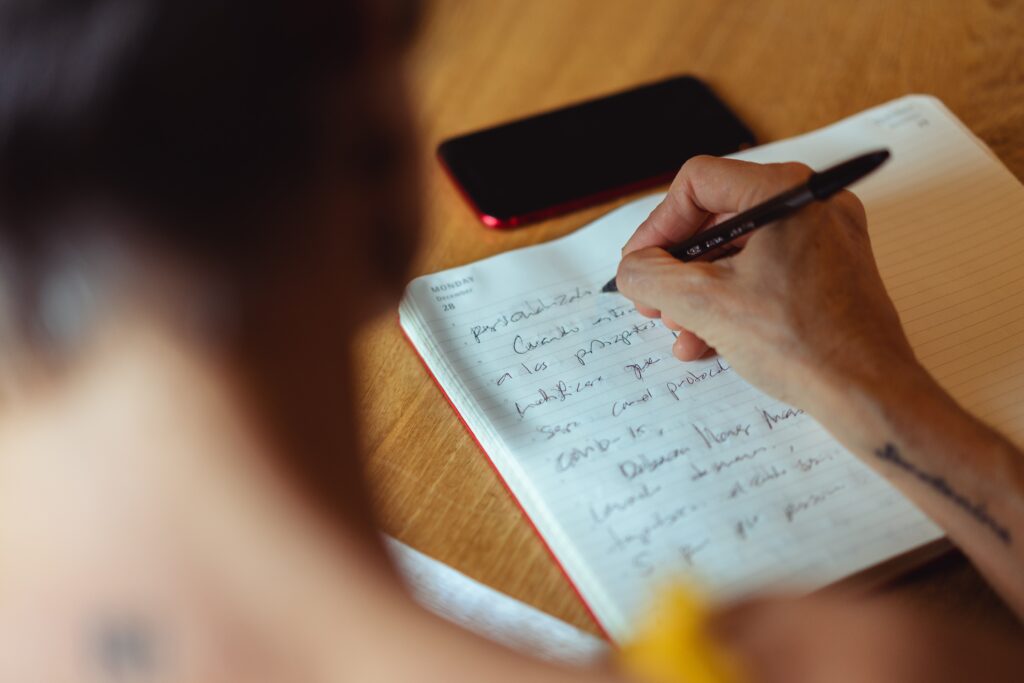
Self-Journaling

When you were younger, and the world seemed to be against you, you probably needed an outlet-we all did.

So you kept a diary, a best friend you could talk to whenever you needed it, with no judgment, punishment, or shame.

You could get all your troubles out onto paper and it would feel like it was lifted off your shoulders.

You may have stopped using a diary once you reached adulthood. But the concept and its benefits still apply.

Now the world calls it journaling. It’s simply writing down your thoughts and feelings to understand them more clearly.

If you struggle with stress, anxiety, depression, or just need to talk to someone and let out your emotions, journaling can be a great outlet.

It can help you gain control of your emotions and improve your mental health.

Benefits of Journaling for Selfcare

Journaling is an intimate and effective way to dive deeper into emotions, allowing you to better understand them and figure out how to better manage and cope with your emotions.

Journaling is a healthy way to express your emotions and can help you understand your mental state better, there are many more benefits to journaling:

-Can help with anxiety management

-Great coping mechanism for stress and reduces it, keeping a journal can help you identify what’s causing that stress.

-Coping with Depression

-Understanding triggers and how to not only cope with them but avoid them as well.

-Allows you to practice positive self-talk

-Improves self-confidence and self-esteem

-Track your fears and draw up plans on how to conquer them

-Identifying and addressing negative thoughts and behaviors and how to suppress them and change the narrative

Journaling is just one way to live a healthier lifestyle, supplement it with other positive practices to better allow you an optimal life.

Other Benefits Of Journaling That Can Assist With Your Daily Life Are:

-Allows you to keep track of and record your goals

-Makes it easier to attain these goals and allows you to record your accomplishments

-Allows you to find inspiration in your daily life, especially with creative journaling.

-Habit tracking, allowing you to maintain and build healthy habits and let go of unhealthy ones.

How To Start Journaling for Mental Health

Journaling for mental health can be a powerful self-help technique that you can start today.

In its simplest form, all you need is a notebook, pen, and a few minutes. You might try journaling if you feel stressed, are having anxiety flare-ups, or find that you’re struggling to deal with your emotions lately. 

There are many ways to journal. Use whatever method feels comfortable, convenient, and easy for you. The most important thing to do is to just begin and figure out what works for you along the way. 

Need help getting started? Try the following tips:

-You don’t have to write first thing in the morning, many people like to journal as soon as they wake up. They try to fill their morning pages while their thoughts are still fresh in their minds. This can be hard to do if you’re like me and need at least ten cups of coffee before you can function. The time of day doesn’t really matter, do it when you feel most comfortable.

-Get some accountability, having a journaling buddy can make it easier to start and help you actually stick with it long enough for you to see results.

-Start small and keep your expectations realistic. Set a small goal to begin with, like writing for 1-5 minutes a day, rather than expecting to fill out five pages instantly. This will allow you to stay consistent and not feel like you’re not doing enough, make your goals small and attainable, and work your way up from there.

-If you’ve got writer’s block, doodle. Journaling is different for us all. Maybe you’re more visual and not so good with words, but you can still benefit from journaling. Just grab a pen and paper and start to doodle, do whatever your mind feels is right. Or look at some journaling prompts to really get you into the writing mood.

As I just mentioned, there are many types of journaling, here are a few of my favorites.

Types of Journaling

There are many different types of journaling, and the key to reaping the full benefits of journaling is finding the right type for you.

Journaling should feel therapeutic and fun, it should be your outlet in the way you feel most comfortable expressing yourself.

If you aren’t sure if journaling is right for you or find yourself struggling to journal daily, you might want to look into the different types of journaling out there. Maybe you just haven’t found the right way to journal for yourself.

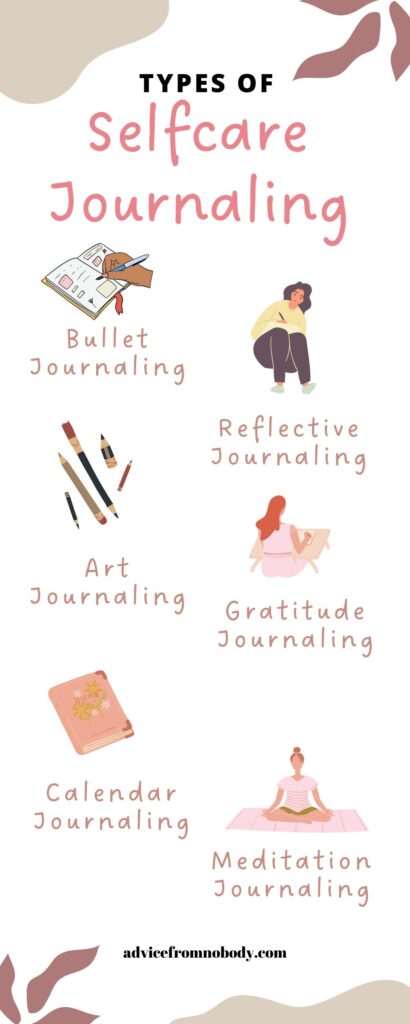
Here are some great different ways to journal:

1. Bullet Journaling

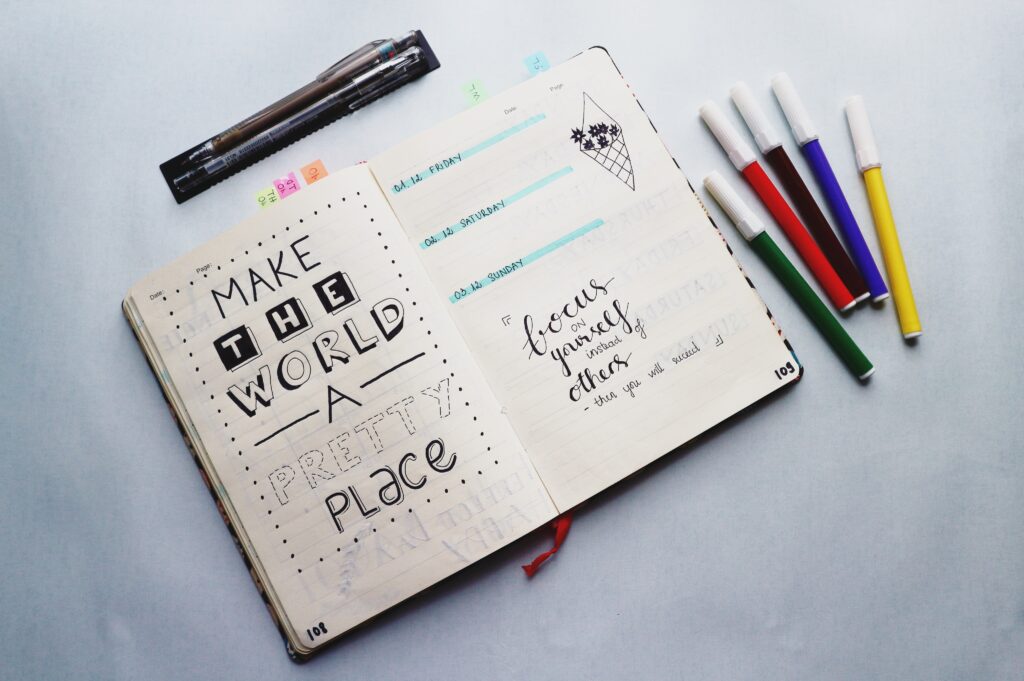
Bullet Journal

Probably the one you’re most familiar with bullet journaling is one of the most popular journaling methods.

You have most likely seen this type of journaling online. They are usually on a dotted or blank page and look like a planner with pretty notes and doodles. A bullet journal is like a planner of sorts, with a more personal touch.

A mental health bullet journal is a place where you can record your thoughts and feelings and support your mental well-being.

Some ways include organizing your day or using it as a wellness and mood tracker, expressing your feelings through a brain dump or morning pages, writing about past events, or practicing gratitude. 

2. Reflective Journaling

A reflective journal or diary is where most people jot down their most important thoughts.

In your reflective journal, you can write about positive or negative events that you are experiencing or experienced, what it means or meant to you, and how it has affected you.

A well-executed reflective journal can impact you positively in so many ways:

–Helps you make sense of your life experiences: When writing in a reflective journal, act as though you are spelling out every small detail to someone who wasn’t present. Sometimes, I like to act like I was witnessing the experience rather than part of it. This can help you gain a new perspective and see it in the eyes of other people that were involved.

–Understanding why something happened: Speculating why something is the way it is can be a very useful exercise in understanding why events take place. Maybe you’ve been blaming yourself for something and don’t understand why it would happen to you. Keeping a reflective journal may help you better deal with those emotions.

–Allows you to use your past to plan your future: After writing about your experience and noting your views on it, think to yourself how you can optimize your views to better plan and achieve your goals. Avoid experiences that have made you feel negative towards yourself and curate the ones that align with your goals.

–Gets thoughts out of your head and makes them more tangible: Writing down your thoughts can help relieve pressure or help resolve problems. It will also help you focus on the tasks at hand.

3. Daily Journaling

Daily journaling is the act of thinking about your life and writing it down each day. That simple.

It’s highly effective, yet super simple. It takes up 5 minutes of your day but can make a huge difference.

With the recent spike in journaling online, with the pretty bullet journals and cute binders, it can seem really intimidating to try it out. You might feel like you want to fit in and do it like everyone else but, I’m here to tell you otherwise. It can certainly be that way for some people, but it doesn’t have to be that way for you.

Take it from me. I simply use a pen and paper to journal daily. I use no prompts, no felt tip pens, just that.

4. Art Journaling

Art journaling is a visual way to express and release your emotions. You can use this outlet to understand your ideas, thoughts emotions, and overall yourself.

There are a number of ways you can use this form of journaling and it can allow you to be as expressive as you want to be.

You can draw, sketch, paint, scribble, collage, photograph, rip, tear, stamp, glue, sew, print, and create in any way you choose.

You think about different things to draw inspiration for, your day, what you ate for breakfast, songs, places you have visited, what you have done this week, or what you plan to do.

The options are endless!

5. Gratitude journaling

Gratitude Journaling

Gratitude journaling is the habit of recording and reflecting on things that you are grateful for on a daily or weekly basis.

It’s typically a way to trick your brain into only focusing on the positives of your day and what you are grateful for. You are basically counting your blessings or listing out all the good things in your life.

Keeping a gratitude journal is a popular practice in positive psychology – the scientific study of happiness.

Feel like you have nothing to be grateful for, Behind The Classroom has a great blog post on 22 Things To Be Grateful For.

6. Calendar Journaling

A calendar journal is basically a journal or diary used to record details of your life such as experiences, feelings, or thoughts.

Whereas a notebook is open and has no structure, a calendar journal provides sections for each day, week, or month. In a calendar journal, each section is used to record events or thoughts relevant to that date.

This allows you to methodically organize your thoughts and experiences and better understand how you felt on specific days, what could have caused it, and how to better cope with your emotions.

7. Meditation Journaling

A meditation journal is a place where you write down what you feel and experience when you meditate. Some people may choose to use the journal they are already keeping as part of their daily lives, while others prefer to use a special book designed especially for meditation journaling.

What you choose to put in your journal is entirely up to you. You can use prompts you find online, or you can simply put down the date, the amount of time you spend meditating, the time and technique, and most importantly how you felt during the meditation.

The journal entry can be a sentence, a paragraph, or just a few words.

Once you start writing and reflecting on your meditation session, more thoughts may come to mind.

8. Creative Journaling

Creative Journal

Creative journaling is a mix of written words and art, all in one place. Doodles and diary entries, colors and poem collections, new ideas, and newspaper clippings… can all find a home on the pages of a creative journal.

There are really no rules when it comes to the creative form of journaling, you just put your pen to paper and allow it to speak for you.

Whatever form of journaling stands out for you, allow yourself to experiment and really find the one that works best for you. Mix and match the types to get your hybrid form of journaling. What’s really important is that you do what works for you.

[jetpack-related-posts]

Why Reading For Mental Health Is Good For You

Filed Under: Mind // 01/17/2023

self help books to read for mental health

What is Mental Health?

Mental health refers to a person’s overall psychological well-being. It includes the ability to manage one’s emotions, thoughts, and behaviors.

It also helps determine how we handle stress, relate to others, and make choices. 

Good mental health is important for overall health and happiness. It can affect how we think, feel, handle stress, make choices, and how we act toward others.

Our mental health can also impact our physical health and overall quality of life.

Some signs of good mental health include feeling good about ourselves, having good and healthy relationships with others, being able to cope with stress and challenges, and being able to enjoy life and allow ourselves to be happy.

Why Your Mental Health is Important

The state of our mental health is important because it plays a significant role in our overall well-being and quality of life.

It affects how we think, feel, and act. It can also impact our physical health, relationships, and ability to function in our daily lives.

It allows us to enjoy life and pursue our goals, rewards us with a sense of well-being, allows us to build positive relationships, and cope with life’s challenges.

However, poor mental health can cause a range of problems, such as difficulty with daily tasks, problems in relationships, and physical health issues.

It’s important to prioritize your mental health and seek help if you are or think you may be experiencing mental health issues. With proper treatment and support, it is possible to improve your mental health and lead a fulfilling and healthy life.

Benefits of Reading for Mental Health

Self-help books can be a helpful resource for anyone looking to improve or maintain their mental health. These books can provide information, tips, and strategies for managing mental health issues and improving overall well-being.

However, it’s important to keep in mind that self-help books are not a substitute for professional mental health treatment.

If you are experiencing significant mental health issues, such as depression, anxiety, or trauma, it’s important to seek help from a qualified mental health professional. They can provide a diagnosis, develop a treatment plan, and offer support and guidance as you work to improve your mental health, something self-help books cannot do.

That being said, self-help books can be a useful addition to professional treatment. They can provide additional tools and strategies for managing mental health issues and promoting overall well-being.

If you’re interested in reading self-help books as part of your mental health journey, it’s a good idea to choose books that are well-reviewed and written by reputable authors and relate to issues you may be having.

It’s also a good idea to discuss your reading plan with a mental health professional to ensure that the books you are reading are appropriate for your needs and don’t pose the threat of doing more damage than good.

Mental Health Reading List Ideas

Books to Read to Heal From Trauma

Here are a few recommendations for books that may be helpful for healing from trauma:

1. The Body Keeps The Score: Brain, Mind, and Body in The Healing of Trauma by Bessel Van Der Kolk

The Body Keeps the Score discusses the ways in which trauma affects the body and the brain, and how it can manifest in various forms of mental and physical illness.

The book draws on the latest research in neuroscience, as well as Van der Kolk’s own clinical experience, to explain the complex relationship between trauma and the brain.

Van der Kolk explores how trauma changes the brain’s structure and function, and how it can lead to problems such as dissociation, anxiety, and depression.

One of the key ideas of the book is that trauma is as much a physical problem as it is psychological. Van der Kolk argues that trauma is stored in the body and can only be fully resolved when it is addressed at the level of mind and body.

The book discusses various treatment approaches, including traditional talk therapy, body-based therapies such as yoga and mindfulness, and pharmacological interventions.

2. Trauma and Recovery by Judith Herman

Judith Herman, a psychiatrist, and researcher at Harvard Medical School focuses on the psychological effects of trauma, particularly in the context of sexual and domestic violence, and the ways in which individuals can recover from these experiences.

Herman discusses the ways in which trauma can disrupt an individual’s sense of self and the importance of finding meaning and purpose in the aftermath of trauma.

She also discusses the importance of social support and community in the recovery process.

One of the key themes of the book is the concept of “complex trauma,” which refers to the long-term effects of repeated or chronic trauma, such as abuse or neglect.

In her book, she argues that complex trauma requires a different approach to treatment than single-incident trauma and that traditional models of therapy may not be effective in addressing the unique needs of individuals with complex trauma.

3. It Didn’t Start With You: How Inherited Family Trauma Shapes Who We Are and How to End the Cycle by Mark Wolynn

Mark Wolynn, a leading expert on inherited family trauma writes about how trauma can be passed down through generations and serves up practical advice for breaking the cycle of inherited trauma.

In the book, Wolynn discusses the concept of “intergenerational trauma,” which refers to the transmission of trauma from one generation to the next through nonverbal communication and behaviors.

He argues that inherited family trauma can manifest in a variety of ways, including physical symptoms, relationship patterns, and emotional and psychological issues.

One of the key themes of the book is the idea that inherited family trauma can be healed through a process of self-inquiry and understanding the root causes of one’s own symptoms and behaviors.

We all suffer from family trauma, it’s up to us to take the necessary steps to heal from it. It may not have started with us, but it can surely end with us.

4. Getting Past Your Past: Take Control of Your Life with Self-Help Techniques from EMDR Therapy by Francine Shapiro

Francine serves up practical advice on using EMDR to overcome the effects of trauma and other negative life experiences.

EMDR stands for Eye Movement Desensitization and Reprocessing and is a psychotherapy that enables people to heal from the symptoms and emotional distress

In the book, Shapiro discusses the concept of “adaptive information processing,” which refers to the brain’s ability to process and integrate negative experiences in a healthy way. She argues that when this process is disrupted by trauma, it can lead to a range of psychological and emotional issues, including anxiety, depression, and relationship problems.

She strongly believes that EMDR therapy can help individuals overcome the effects of trauma and other negative life experiences by accessing and processing previously unresolved memories and emotions.

She offers up a range of practical tools and techniques for using EMDR to improve mental health and overall well-being, including exercises for identifying and processing unresolved memories and emotions, and strategies for managing stress and building resilience.

5. The Mindful Self-Compassion Workbook: A Proven Way to Accept Yourself, Build Inner Strength, and Thrive by Kristin Neff and Christopher Germer

In this book, Neff and Germer give us practical exercises and strategies for cultivating self-compassion.

Neff and Germer argue that self-compassion is a key component of mental health and well-being and that it can be developed through the regular practice of mindfulness and other self-compassion exercises.

They offer a range of practical tools and techniques for cultivating self-compassion, including exercises for developing a caring and supportive inner voice, techniques for managing difficult emotions, and strategies for building resilience.

Books to Read for Dealing With Burnout

1. Burnout: The Secret to Unlocking the Stress Cycle by Emily Nagoski and Amelia Nagoski

Burnout. We’ve all experienced it. What’s expected of women and what it’s really like to be a woman in today’s world are two very different things—and women exhaust themselves trying to close the gap between them.

In Burnout, sisters Emily and Amelia Nagoski deconstruct the stress we experience as women and their compassionate, science-based advice on how to release it resonated with me. The book is revolutionary and its authors are wonderful and wise.

This is a great book to help women move through stress and stop beating themselves up.

2. Can’t Even: How Millennials Became The Burnout Generation by Anne Helen Petersen

Can’t Even: How Millennials Became The Burnout Generation is a book by Anne Helen Petersen that explores the phenomenon of burnout among millennials and the factors that contribute to it.

According to Helen, burnout is characterized by feelings of exhaustion, cynicism, and detachment, and it can be caused by a variety of factors, including overwork, social media, and the pressure to constantly be productive.

Petersen outlines how burnout impacts millennial lives, the generational circumstances that got them there in the first place, and what burnout does to a generation in the long term.

3. Manage Your Day-to-Day: Build Your Routine, Find Your Focus, and Sharpen Your Creative Mind by Jocelyn K. Glei

Manage Your Day-to-Day offers practical advice and tools for managing time and maximizing productivity.

The book is organized into three sections: “Build Your Routine,” “Find Your Focus,” and “Sharpen Your Creative Mind.”, all to avoid feeling overwhelmed and getting burnt out.

In the “Build Your Routine” section, the book offers strategies for establishing a consistent daily routine, including setting priorities, managing your energy, and creating a healthy work environment.

The “Find Your Focus” section discusses techniques for staying focused and avoiding distractions, such as setting limits on social media use and using the Pomodoro Technique to break tasks into manageable chunks.

The “Sharpen Your Creative Mind” section explores ways to stimulate creativity and generate new ideas, such as setting aside dedicated time for creative work, seeking out new experiences, and collaborating with others.

The book offers a variety of strategies and techniques that can help you build a healthy and productive daily routine, stay focused, nurture your creativity and avoid the dreadful monster that is burnout.

4. Do Nothing: How to Break Away from Overworking, Overdoing, and Underliving by Celeste Headlee

Do Nothing explores the negative effects of the culture of overworking and overachievement and offers strategies for reclaiming our time and finding balance in our lives.

In the book, Headlee argues that our obsession with productivity and achievement is leading us to neglect our own well-being and that of our communities.

She discusses the importance of taking breaks and finding ways to disconnect from the constant demands of work and technology. She also offers practical advice for establishing healthy habits and finding ways to prioritize rest and relaxation.

Do Nothing is a thought-provoking examination of our culture of overworking and a helpful guide for anyone looking to reclaim their time and find balance in their lives.

She offers a variety of strategies and techniques for breaking away from the cycle of overworking and overdoing and finding more time for rest, relaxation, and meaningful connection with others.

5. The Headspace Guide to Meditation and Mindfulness by Andy Puddicombe

The Headspace Guide to Meditation and Mindfulness by Andy Puddicombe introduces the practice of meditation and mindfulness and offers guidance for establishing a daily meditation practice.

Puddicombe explains the benefits of meditation and mindfulness, including reducing stress, improving focus and concentration, increasing feelings of happiness and well-being, and avoiding burnout.

He also provides a variety of meditation techniques and exercises, as well as tips for establishing a daily meditation practice and making meditation a part of your daily routine.

Books to Read for Handling Stress and Anxiety

1. The Anxiety and Phobia Workbook by Edmund J. Bourne

The Anxiety and Phobia Workbook offers strategies and techniques for managing anxiety and stress. The book is designed to help readers identify the causes of their anxiety and stressors and develop coping strategies to manage and reduce their symptoms.

The book covers a wide range of anxiety-related issues, including panic attacks, social anxiety, generalized anxiety disorder, and specific phobias.

It includes exercises and activities to help readers identify and challenge negative thoughts and beliefs, relax their bodies, and develop coping skills for managing anxiety and phobias. It also provides guidance for seeking professional help and working with a therapist to address anxiety and phobias.

Overall it is a comprehensive and practical resource for anyone looking to better understand and manage their anxiety, phobias, and stress. It offers a variety of strategies and techniques that can help readers reduce their symptoms and improve their overall well-being.

2. The Relaxation and Stress Reduction Workbook by Martha Davis, Elizabeth Eshelman, and Matthew McKay

The Relaxation and Stress Reduction Workbook offers strategies and techniques for managing stress and promoting relaxation.

The book is designed to help readers identify the sources of their stress and develop coping strategies to manage and reduce their stress levels.

The book covers a wide range of stress-related issues, including time management, communication skills, and coping with change. It includes exercises and activities to help readers identify and challenge negative thoughts and beliefs, relax their bodies, and develop coping skills for managing stress.

It also provides guidance for seeking professional help and working with a therapist to address stress and related issues.

3. The Worry Cure: Seven Steps to Stop Worry from Stopping You by Robert L. Leahy

The Worry Cure is a self-help book by Robert L. Leahy that offers strategies for managing and reducing worry and anxiety. In the book, Leahy discusses the causes of worry and anxiety and provides a seven-step program for overcoming them.

The seven steps outlined in the book include:

1. Identifying and challenging negative thoughts and beliefs

2. Setting goals and priorities

3. Developing problem-solving skills

4. Using relaxation techniques to manage physical symptoms of anxiety

5. Engaging in enjoyable activities

6. Seeking social support

7. Seeking professional help when necessary

Throughout the book, Leahy provides exercises and activities to help readers implement these strategies and overcome their worries and anxiety.

4. The Stress-Proof Brain: Master Your Emotional Response to Stress Using Mindfulness and Neuroplasticity by Melanie Greenberg

The Stress-Proof Brain is a self-help book written by Melanie Greenberg, a clinical psychologist, and expert on stress and emotion regulation.

In her book, Greenberg explores the latest research on the brain’s response to stress and how we can use mindfulness and neuroplasticity (the brain’s ability to change and adapt) to better manage our emotional reactions.

The book presents a number of strategies and techniques for reducing stress and improving well-being, including mindfulness practices, cognitive-behavioral techniques, and self-care practices.

Greenberg also discusses how to communicate effectively and build supportive relationships, which can be an important part of stress management.

Her goal is to help readers develop a more resilient and stress-proof brain and to live a happier, healthier life

5. Be Calm: Proven Techniques to Stop Anxiety Now by Jill Weber

Be Calm is a great workbook for managing and reducing anxiety. In the book, Weber discusses the causes of anxiety and provides a range of strategies for overcoming it.

Some of the strategies discussed in the book include:

–Identifying and challenging negative thoughts and beliefs

–Practicing relaxation techniques such as deep breathing and progressive muscle relaxation

–Engaging in physical activity and other enjoyable activities

–Seeking social support and building healthy relationships

–Seeking professional help when necessary

Throughout the book, Weber provides exercises and activities to help readers implement these strategies and reduce their anxiety.

Books to Read When You’re Feeling Depressed

1. Feeling Good: The New Mood Therapy by David D. Burns

This book provides mechanisms for managing and improving mood.

The book is based on the principles of cognitive-behavioral therapy (CBT), which is a type of therapy that focuses on changing negative patterns of thought and behavior.

In the book, Burns discusses the causes of negative moods and provides a range of strategies for improving them.

He covers topics such as identifying and challenging negative thoughts, setting goals and solving problems, and building healthy relationships. He also provides exercises and activities to help readers implement these strategies and improve their moods.

2. The Depression Cure: The 6-Step Program to Beat Depression without Drugs by Stephen Ilardi

This book provides a natural, research-based approach to managing and overcoming depression.

The Depression Cure argues that depression is largely a result of a mismatch between the way our minds and bodies evolved to function and the way we live today.

Ilardi presents a number of strategies for overcoming depression, including exercise, sunlight, sleep, and social support, as well as dietary and lifestyle changes. The book also includes a number of exercises and techniques for managing stress and improving mood.

3. The Mindful Way through Depression: Freeing Yourself from Chronic Unhappiness by Mark Williams, John Teasdale, Zindel Segal, and Jon Kabat-Zinn

The Mindful Way through Depression is a self-help book that combines the principles of mindfulness and cognitive-behavioral therapy to help readers overcome depression.

The authors are all leading experts in the field of mindfulness and mental health.

In the book, they present a step-by-step program for overcoming depression, including exercises for developing mindfulness skills and techniques for changing negative thought patterns.

The book also includes guided meditations and other mindfulness practices to help readers stay present and focused in the present moment. The goal of the book is to help readers break the cycle of negative thinking and cultivate lasting happiness and well-being.

4.  The Noonday Demon: An Atlas of Depression by Andrew Solomon

A writer and lecturer on psychology, politics, and the arts, Solomon, provides us with a personal and cultural exploration of depression, drawing on his own experience with the disorder as well as the stories of others who have struggled with it.

Solomon also explores the history, science, and cultural impact of depression, and he discusses a wide range of treatments, including medication, therapy, and alternative approaches.

The Noonday Demon is widely considered a classic work on depression, and it has received numerous accolades for its depth, insight, and humanity.

5. The Happiness Trap: How to Stop Struggling and Start Living by Russ Harris

In the book, medical doctor and psychotherapist, Harris argues that our pursuit of happiness often leads to suffering and disappointment, and he presents a new approach to finding lasting well-being.

The book is based on the principles of acceptance and commitment therapy (ACT), a form of cognitive-behavioral therapy that emphasizes acceptance, mindfulness, and taking meaningful action.

Harris suggests that by learning to accept our thoughts and feelings, rather than struggling against them, we can break free from the “happiness trap” and live a more fulfilling and meaningful life.

The book includes a number of exercises and techniques for practicing ACT, as well as guidance for applying the principles to different areas of life.

Other Ways to Improve Your Mental Health

There are many different ways to improve your mental health. Here are a few strategies that you can try:

1. Exercise regularly: Physical activity has been shown to have numerous benefits on our mental health, including reducing stress, improving mood, and increasing self-esteem.

2. Eat a healthy diet: A healthy diet can provide your body and mind with the nutrients they need to function optimally.

3. Getting enough rest: Adequate sleep is important for mental health, as it helps to repair and restore the body and mind.

4. Practice stress management techniques: There are many different stress management techniques that you can try, such as deep breathing, meditation, and mindfulness.

5. Stay connected: Maintaining social connections is important for mental health. Consider joining a group or club, volunteering, or simply spending time with friends and loved ones.

Remember that it’s important to find the strategies that work best for you. It may take some trial and error to find what works best, but with persistence and a positive attitude, you can improve your mental health.

When to See a Professional

There are several signs that it might be time to seek help from a mental health professional:

1. You’re experiencing persistent and intense emotions, such as sadness, anxiety, or anger, that interfere with your daily life.

2. You’re having difficulty with relationships or completing your daily tasks.

3. You’re experiencing changes in your appetite, sleep patterns, or energy level.

4. You’re having harmful thoughts towards yourself and/or others.

5. You’re using alcohol or drugs to cope with your emotions.

6. You’re feeling disconnected from reality or experiencing hallucinations.

7. You just don’t feel like yourself anymore.

If you’re experiencing any of these symptoms, it’s important to seek help from a mental health professional. They can help you determine the cause of your symptoms and develop a treatment plan to address them.

However, you know yourself best, no matter what symptoms you may or may not be experiencing, you can always seek professional help if you feel so. There is no one-size-fits-all, listen to your emotions, body, and soul.

Don’t hesitate to reach out for support if you need it.

[jetpack-related-posts]

Essentials For The Perfect At-Home Spa Day

Filed Under: Self Care // 01/09/2023

Visiting a spa is one of the oldest forms of self-care out there. Facials, full-body massages, and mud baths, what else’s could you hope for?

But spas can get pretty pricey, pretty quickly.

Instead, taking the DIY route can be cheaper and you may even enjoy it more. Having the feel of a luxury spa in the comfort of your home.

So for your next at-home spa day, here are all the essentials you could possibly need.

Fluffy White Robe

Can you even think of a spa and not see a fluffy white robe? Emulate the experience you get from a spa right in your own home by wrapping yourself in this warm comfy robe.

Jade Roller or Gua Sha

When stored in the fridge, the cooling stone (when stored in a skincare fridge) of a gua sha or jade roller can reduce the appearance of puffiness and help you relax and unwind.

You can use it to massage your face and stimulate lymphatic drainage.

Bath Bombs or Shower Bombs

Whether you want one because of its relaxing scent or because you think they are pretty. Bath/Shower bombs are great for transforming any bathtime routine into a luxury experience. Indulge your senses whenever you take a bath or shower.

Bath Salts

Accompanied with a bath bomb, a handful of these bath salts will work wonders in transforming your bath into a luxury experience.

Not to mention, the soothing effects on sore muscles and relax your mind.

Body Scrubs

Body scrubs are great for removing dirt and dead skin cells from your body. They can cleanse your skin and give you a healthy glow. Not to mention, you’ll be left smelling wonderful.

Dry Brush

Dry brushing works by exfoliating the skin. It is a body massage you give yourself with a stiff bristled brush with nothing on it.

It can help remove dry, flaky skin from your body.

Face Masks

You cant have an at-home self-care spa day without a face mask. Whether it’s a Tumeric sheet mask, activated charcoal mud mask, or a brightening face mask.

Face masks include ingredients that can hydrate your skin and give you a healthy, youthful glow.

Facial Steamer

Your face gets polluted with dirt dust and makeup every day and steaming your face is a great way to leam off the grime and open up your pores.

Using a facial steamer designed to work with essential oils for a spa-like facial at home.

Use a mix of lavender and tea tree oil for acne-prone skin or lavender and rosehip for dry skin.

Candles

Lighting your favorite candle will add a calming effect to your at-home spa day. I like to use lavender-scented candles for a soothing effect or eucalyptus after I have had a long hard day.

Lighting the right scent can transform you into anywhere you want to be.

Lip Scrub

Lip scrubs are by far the easiest scrubs to do. They help exfoliate chapped lips and will leave them feeling plump and hydrated.

Aromatherapy Body Lotion

Aromatherapy lotion has become part of my daily self-care routine. They are ultra creamy, fast absorbing with nourishing vitamins, and are formulated to give your skin long-lasting moisture.

Essential Oils

No matter what the occasion, you’ll always need essential oils for any self-care day. Here is a list of essential oils for all your needs:

–Lavender: Calming, reduces anxiety, and promotes better sleep and relaxation.

–Eucalyptus: Soothing and relaxing.

–Chamomile: Calming scent that can aid in sleep.

–Orange: Mood-boosting and energizing, perfect for meditation.

–Lemongrass: Soothing, uplifting, and anxiety-reducing.

Incense

Sandalwood incense is often burned to create a comforting and peaceful environment to help with uplifting your mood.

Diffuser

Paired with your favorite essential oils, a diffuser can help indulge your senses and take you to a great place of relaxation.

Comfy Slippers

Paired with your fluffy white robe, slippers will leave you feeling warm and snuggled up.

Hair Mask

Hair masks can help moisturize and nourish your hair. They’re especially beneficial for dry, damaged, or frizzy hair.

Some hair masks may improve the health of your scalp and boost hair strength of dry brittle hair.

Foot Spa

Foot baths are affordable and compact, but can work wonders on tired and sore feet. Accompanied by bath salts and warm water, you can create your own at-home salon and have yourself a luxury experience.

Bath Caddy

Designed to rest across your tub and give you space for everything you could possibly need or want on hand (your candles, a book, a tablet, and yes, even a glass of wine), a bath caddy is exactly what you need to soak your cares away.

Jacuzzi Mat

There are a few things, that we have mentioned, you can do to make your warm bubble bath even more relaxing! Take your spa experience to another level by adding a jacuzzi mat to your bathtub to transform it into a jacuzzi.

Equipped with all the essentials for the perfect spa day, you are now ready to transform your home into a luxury spa.

[jetpack-related-posts]

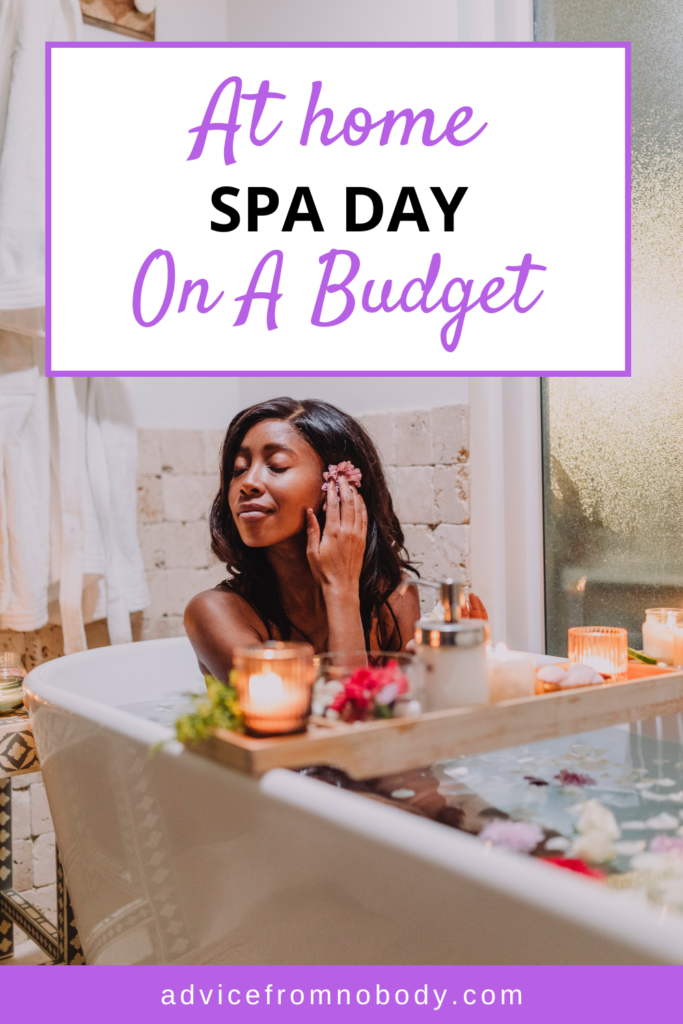
How to Have a Budget Spa Day At Home

Filed Under: Self Care // 01/02/2023

Every now and then, life gets the best of us, and we’re left feeling tired and overwhelmed, and just needing to unwind.

A spa day would help you get well-deserved rest, but fancy hotel spas can get pretty pricey and fast.

Setting up your own at-home spa is easy! Follow these easy steps to set up your pamper day in the comfort of your home.

Benefits of DIY Spa Day

1. Helps to destress:

A relaxing spa day at home is one of the best ways to relieve the week’s stress and quiet your mind.

No matter the treatment, you’re going to notice that your mind immediately begins to feel at ease when you pamper yourself and finally treat yourself to a rare and highly deserved moment of “me” time and a self-care day.

Just a few of our suggested relaxing at-home spa treatments will leave you feeling rejuvenated and refreshed.

2. Enhances your sleep:

Getting proper sleep is vital, yet can be really hard to achieve. Many of us are so busy that we don’t have enough time in a day to get well rested.

With stress from work, school, relationships, and overall responsibilities, the time we do spend in bed can be stressful and our minds just don’t seem to want to shut off.

After a wonderful time of facials, self-pampering, and body treatments, your body will naturally unwind for a great night’s sleep.

3. Makes you a happier person:

As if you needed even more reasons, spas are healing to both your mind and soul. It allows your mind to clear out all your negative thoughts.

Add in the factor of being in your own home, so much serotonin and dopamine-you might just overdose.

This is why many people who suffer from depression choose to regularly treat themselves to a relaxing spa treatment and there are many more benefits to pampering yourself.

4. Self-Care:

If you’re looking to enhance your self-confidence, you can rest assured that plenty of these treatments are incredibly effective. You can use this chance to address any beauty concerns you may haven’t had any time to take care of lately.

Acne breakouts, split ends, dull hair, or any chipped nail you haven’t had time to attend to.

At the end of the day, you’re going to feel significantly better after you’ve treated yourself to this amazing pamper day in your at-home spa.

It’s only natural to feel your best self after pampering yourself. Whether you treat yourself with a facial, a pedicure, or an aromatherapy shower. 

Either way, you can look forward to ending the night feeling radiant and the best version of yourself.

Step 1: Preparing for your Selfcare day

Supplies for at home spa day

For the perfect at-home spa day, preparation is key. Having an at-home spa day checklist will help you figure out everything you need.

Have all your supplies ready and at hand to avoid any distractions and not break your flow of relaxation at any point.

Taking the time to ensure that you have everything you need allows you to stay in the moment and make this spa day the best you’ve ever had.

Step 2: Set the Scene for your at-home spa day

The reason why spas are so successful is that they know exactly how to engage all your senses, getting your mind and body instantly relaxed.

You can recreate this tranquil atmosphere with these simple steps.

–The Perfect Scent: Aromatherapy plays a vital role in helping your mind and body to relax and release. Consider setting up your diffuser with your favorite essential oils. I recommend lavender, chamomile, or eucalyptus for stress relief, especially after a long day.

–Create Ambiance with Lighting: Light a few of your favorite candles, dim the light and burn some incense. This will make your home feel warm and cozy, adding to the aromatherapy and relaxing scents from the diffuser.

–Set the Tone With Good Music: The right type of music can really make you feel like you’re in a luxury spa. The music can help drown out any noise around you and isolate you for your night. You can try using beach sounds or waves instead of music for an even more tranquil atmosphere.

–Get Cosy: Throw on a fluffy white robe and soft slippers, the warmth on your skin will really transport you to luxury.

Step 3: Spa Ideas: Activities and Treatments

Now that your scene has been set and you’ve acquired all your supplies. It’s time to relax.

Here is a list of activities and treatments that will leave you feeling pampered and refreshed.

1. Soak Away Your Day With a Warm Bubble Bath

Pamper day spa at home

Draw a hot relaxing bath and pour in a soothing bath salt or moisturizing bath bomb. Surrounded by your candles and calming music, your bath will set you up for the best spa day you’ve ever experienced.

-Use essential oils, bath salts, and a bath bomb for an aromatherapy bath time.

-To better enjoy your glass of wine, read your favorite book, or watch an entertaining show in your bath, set up your bath caddy to make your experience as luxe as possible.

-Invest in a jacuzzi mat, a jacuzzi bath mat is a long mat with suction cups under it. You attach it to the bottom of your bathtub and connect an air hose that blows bubbles into your tub, massaging your back in the process so are heated to allow for a more thorough massage.

–Meditate, quiet your mind, and be fully in the present. Focus on your breathing and reflect on the day you’ve had, really wind down, and allow yourself to relax.

2. At Home Steam Facial

Follow this six-step facial to make your skin feel purified and pampered.

–Cleanse: Start your home spa facial with pure, clean skin. Lift away any impurities with your favorite cleanser. Use it twice for a double cleanse.

–Exfoliate: Now follow up with a gentle face scrub, you can choose between a chemical or a physical exfoliant. Exfoliating can be vital in an anti-aging skincare routine, as it can help encourage healthier growth. Clean skin is healthier skin all around.

-Steam Facial: Now that you have a clean fresh face, we can use a facial steamer designed to work with essential oils and open up your pores. You can also use a pot and water to steam your face if you don’t have a steamer.

–Face mask: Throw on a replenishing and hydrating face mask to add moisture back to your skin.

-Facial massage: After you remove the face mask, treat yourself to a facial massage. Grab an ice-cold jade roller or gua-sha(that you’ve stored in your skincare fridge beforehand). This will boost blood circulation, reduce bags under your eyes, increase lymphatic drainage, and allows for the absorption of product into your skin.

–Moisturize: Finnish off your facial with your favorite moisturizer to really lock in the moisture.

3. Put on a Hair Mask

No matter what your hair care needs may be, a hair mask is always an ideal curly hair product to have for the health of your hair.

They are formulated to strengthen hair, moisturize hair and improve its condition and can ultimately reduce hair breakage, smooth frizz, make the hair more manageable, enhance shine, and feel less dry.

Throw one on before your bath or while you’re busy with your facial.

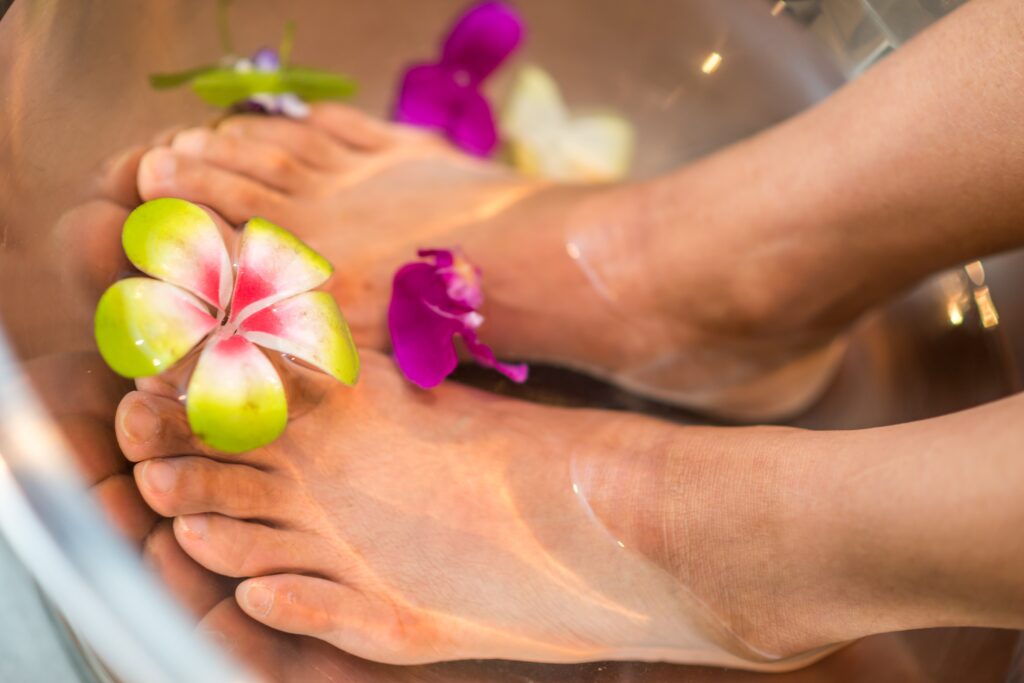
4. Give Yourself A Pedicure And At-home Foot Spa

As long as you have a handful of tools, it won’t be too hard to DIY your at-home foot spa.

At home pedicure for pamper day

–Step 1: Remove old nail polish with a cotton ball and nail polish remover.

-Step 2: Soak your feet in a warm foot bath. Add in a good Epsom salt if your feet are sore. Soak for about 10-15 minutes or until the water runs cold.

–Step 3: Trim and file your nails.

-Step 4: Give yourself a massage. Put on a good moisturizer and massage your feet and toes for a few minutes.

–Step 5: Remove oil with a cotton pad to allow the polish to go on smoother.

–Step 6: Apply your base coat then follow up with your nail polish.

-Step 7: Finnish it off with a top coat.

5. Pamper your Hands and Nails

Now that you’ve had a pedicure, treat yourself to a DIY manicure. Massage your hands and cuticles with a hand balm or cuticle cream.

–Step 1: File Your Nails to your desired length and shape.

–Step 2: Soak Your Nails, apply your favorite hand cream, then, soak your nails in warm, soapy water for a few minutes to soften the cuticles.

–Step 3: Push back your cuticles with a wet nail stone.

–Step 4: Apply a base coat, it will help the color go on smoothly and last longer.

-Step 5: Apply two coats of your color of choice, waiting in between coats to dry. (Apply thin layers for an even finish).

-Step 6: Apply a top coat to seal it all in.

For a more fun and modern manicure, try out our micro French manicure tutorial.

6. Exfoliate your Skin

After you’ve dry-brushed your skin, go in with a gentle exfoliant( preferably a chemical exfoliant to avoid irritating your skin too much).

This will help brighten up your complexion, increase circulation, and can give you a radiant healthy glow.

7. Try Out Dry Brushing

Self care day skin care

Dry brushing is a method of gently exfoliating your skin using a special firm-bristled brush.

Some people use it as part of their skin routine to try to restore firmness, get rid of dry skin flaking, and encourage blood flow to certain areas of the body. Dry brushing has roots in the healing practices of ancient cultures.

Brushing before a shower is best. The bristles of a dry brush can exfoliate your skin, and showering afterward should help wash away any dead, flaky skin cells.

Dry brushing unclogs pores in the exfoliation process. It also helps detoxify your skin by increasing blood circulation and promoting lymph drainage, it also makes it easier for the body to sweat and eliminate toxins in your system.

8. Have an Aromatherapy Shower

Maybe you don’t quite enjoy baths/or don’t have access to a bathtub. You can actually create a spa-like experience in your shower.

Hang some eucalyptus under your shower head for a boost of energy and relaxation. Take a hot shower with your favorite shower bomb to compliment the eucalyptus scent, I suggest using the …bath bomb to help you relax.

9. Have a Relaxing “Massage”

After a long day, your body may be sore and need to release some tension. Eucalyptus essential oils can help make everything better with their healing capabilities.

After a good rub down of this oil, you’ll feel almost as good as just having come out of a great spa aromatherapy massage.

10. Try a Lip Mask

Lip masks are easy and often forgotten—just pick an extra-hydrating balm and slather on a thick layer before bed, or whenever your lips are chapped.

This small thing can make a huge difference in the plumpness and appearance of your lips, allowing you to look your best all the time.

I hope you’ll make some time to try this at-home spa day. Taking care of yourself is important, and this is such an easy way to relax and unwind.

[jetpack-related-posts]
  • « Previous Page
  • 1
  • …
  • 5
  • 6
  • 7

Copyright © 2026 · Theme by Marketing Templates Co.

We use cookies on our website to give you the most relevant experience by remembering your preferences and repeat visits.Read More By clicking “Accept All”, you consent to the use of ALL the cookies. However, you may visit "Cookie Settings" to provide a controlled consent.
Cookie SettingsAccept All
Manage consent

Privacy Overview

This website uses cookies to improve your experience while you navigate through the website. Out of these, the cookies that are categorized as necessary are stored on your browser as they are essential for the working of basic functionalities of the website. We also use third-party cookies that help us analyze and understand how you use this website. These cookies will be stored in your browser only with your consent. You also have the option to opt-out of these cookies. But opting out of some of these cookies may affect your browsing experience.
Necessary
Always Enabled
Necessary cookies are absolutely essential for the website to function properly. These cookies ensure basic functionalities and security features of the website, anonymously.
CookieDurationDescription
cookielawinfo-checkbox-analytics11 monthsThis cookie is set by GDPR Cookie Consent plugin. The cookie is used to store the user consent for the cookies in the category "Analytics".
cookielawinfo-checkbox-functional11 monthsThe cookie is set by GDPR cookie consent to record the user consent for the cookies in the category "Functional".
cookielawinfo-checkbox-necessary11 monthsThis cookie is set by GDPR Cookie Consent plugin. The cookies is used to store the user consent for the cookies in the category "Necessary".
cookielawinfo-checkbox-others11 monthsThis cookie is set by GDPR Cookie Consent plugin. The cookie is used to store the user consent for the cookies in the category "Other.
cookielawinfo-checkbox-performance11 monthsThis cookie is set by GDPR Cookie Consent plugin. The cookie is used to store the user consent for the cookies in the category "Performance".
viewed_cookie_policy11 monthsThe cookie is set by the GDPR Cookie Consent plugin and is used to store whether or not user has consented to the use of cookies. It does not store any personal data.
Functional
Functional cookies help to perform certain functionalities like sharing the content of the website on social media platforms, collect feedbacks, and other third-party features.
Performance
Performance cookies are used to understand and analyze the key performance indexes of the website which helps in delivering a better user experience for the visitors.
Analytics
Analytical cookies are used to understand how visitors interact with the website. These cookies help provide information on metrics the number of visitors, bounce rate, traffic source, etc.
Advertisement
Advertisement cookies are used to provide visitors with relevant ads and marketing campaigns. These cookies track visitors across websites and collect information to provide customized ads.
Others
Other uncategorized cookies are those that are being analyzed and have not been classified into a category as yet.
SAVE & ACCEPT